

Summary
We are taught to treat discipline as a moral quality, something stored inside a person and strengthened through effort, as if consistency were the visible proof of inner virtue. Yet stable behavior does not originate in personality; it arises from conditions.
Motivation rises and falls with sleep and stress, attention narrows under pressure, and cognitive bandwidth is more limited than we like to admit. When environments are poorly structured, even intelligent and capable people falter in predictable ways, not because they lack character, but because the system around them demands more regulation than the mind can reliably supply. When friction is lowered and prompts are stable, the same individuals appear steady and composed, and consistency feels ordinary rather than heroic.
Discipline, then, is not a character upgrade waiting to be earned; it is the outcome of aligned systems operating within human limits. In an era defined by overload and increasingly intelligent tools, the real advantage belongs to those who design environments that absorb human variability instead of trying to overpower it.
The Moralization of Consistency
If discipline were truly a personality trait, it would express itself consistently across contexts. The person who manages money carefully would also eat well under stress; the one who keeps a clean inbox would maintain composure during conflict; the early riser would resist impulsive spending late at night. Yet real life rarely conforms to that symmetry. People are meticulous in one domain and scattered in another, focused at work and distracted at home, attentive with clients yet neglectful of themselves. The variation is so common that it should no longer surprise us, and yet we continue to interpret it as inconsistency of character rather than inconsistency of conditions.
This unevenness is often framed as hypocrisy or weakness, but it is more accurately described as context dependence. Behavior does not travel intact across environments because environments are not neutral; they shape what is easy, what is visible, and what demands effort. Discipline is not stored somewhere inside you, waiting to be deployed uniformly. It emerges when specific conditions align, when cues are reliable, when friction is manageable, when cognitive load is tolerable. Alter those conditions and the pattern shifts, even if the underlying person remains unchanged.
The confusion begins with language. We describe someone as disciplined as if we were describing height or eye color, a fixed attribute that exists independently of circumstance. The word implies permanence and suggests an internal quality that can be strengthened through sheer effort, carrying subtle moral undertones that divide people into categories of strong and weak without examining the architecture that surrounds them. If discipline were purely internal, it would not fluctuate so predictably with sleep deprivation, emotional strain, or structural complexity; the fact that it does should prompt us to reconsider where we believe it lives.
The Illusion of Internal Strength
Culturally, we are trained to admire visible self control. We celebrate the student who studies while others relax, the executive who never misses a workout, the parent who maintains composure under pressure, and we treat these patterns as proof of inner strength. The narrative is clean and satisfying: discipline lives inside the person, and effort reveals it. What rarely enters the story is the invisible scaffolding that makes those performances sustainable, the structures that quietly lower friction and stabilize cues so that effort does not have to carry the entire load.
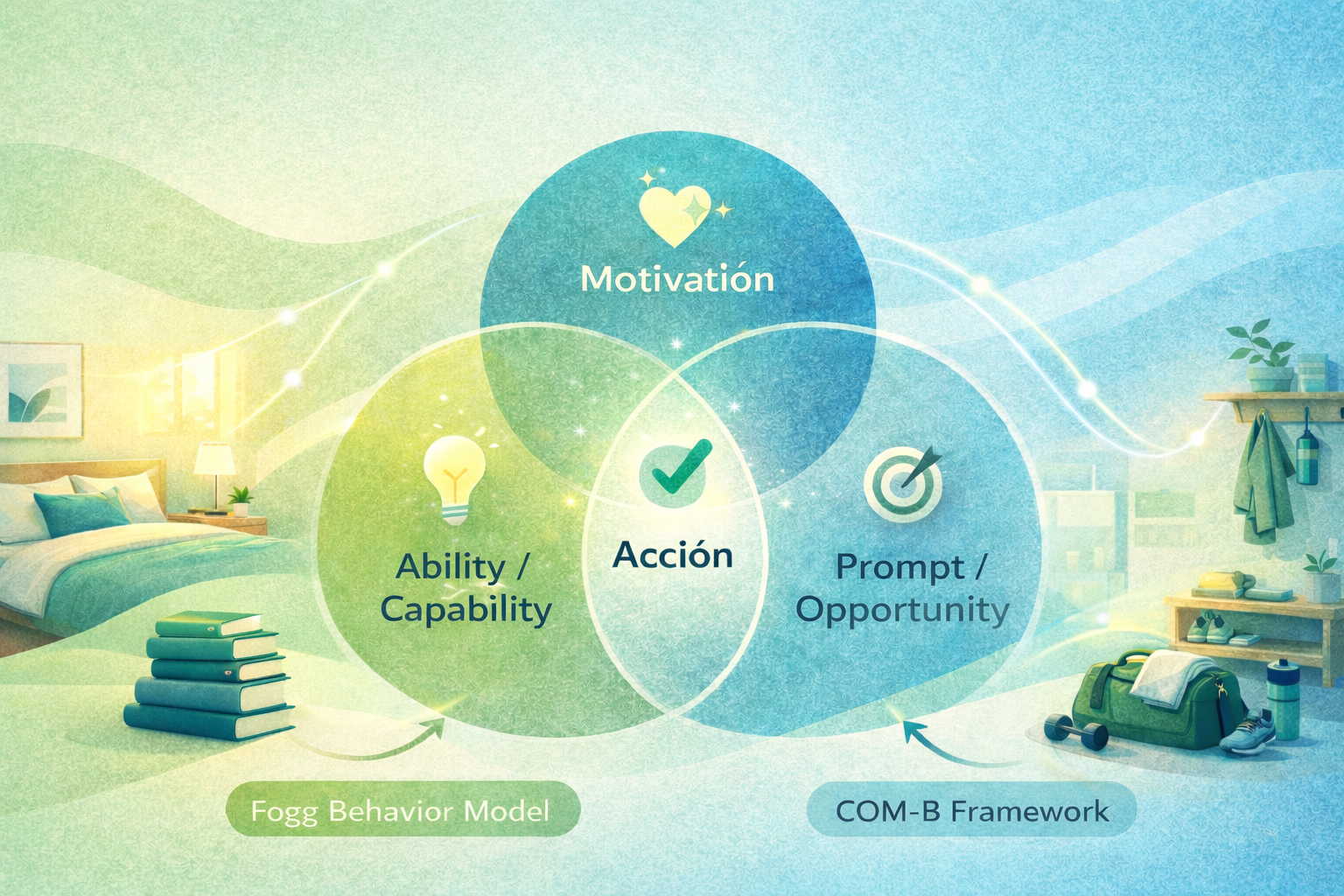
Behavioral science offers a more precise lens. The Fogg Behavior Model proposes that action occurs when motivation, ability, and prompt converge at the same moment, while the COM B framework similarly argues that behavior requires capability, opportunity, and motivation. Neither model elevates personality as the primary driver; both direct attention to conditions. They ask whether the task is simple enough, whether the cue is present, whether the environment makes the behavior feasible at the exact moment it is required.
When someone appears disciplined, it is often because ability is high and prompts are reliable, because the task is clearly defined, the environment supports execution, and the timing aligns with available cognitive bandwidth. Under those circumstances, even moderate motivation is sufficient, and the behavior looks effortless from the outside. The appearance of strength may in fact be the presence of alignment.
Remove one of those conditions, and the pattern changes. Increase complexity and ability drops; remove the cue, and the action becomes dependent on memory; raise cognitive load, and motivation must stretch to compensate. When it cannot, the behavior falters, not because the person has changed, but because the convergence has dissolved. What we call discipline is frequently the byproduct of simplicity and timing, a structural harmony that makes consistency look like character.
Context Is the Real Variable
Notice how behavior shifts with physical location. At the office, you may feel focused and methodical, moving through tasks with clarity; at home, the same mind drifts toward distraction. On vacation, routines that once felt stable quietly dissolve, and during a demanding project, financial tracking may slip without any dramatic decision to abandon it. None of these changes require a transformation in character, they require only a shift in context. The person remains constant, but the surrounding conditions reorganize what feels easy and what feels effortful.
Research on habit formation helps explain why this happens. Automaticity depends heavily on stable cues, which means that when a behavior is repeatedly performed in the same setting, the environment itself begins to trigger the action. The cue reduces the need for deliberation, allowing the behavior to unfold with less conscious effort until it feels natural. When that person is placed in a new environment, however, the cue often disappears, and without that structural support the habit weakens, not because motivation vanished, but because the trigger did.
This is why moving to a new city can disrupt both constructive and destructive patterns, as the environmental signals that once sustained them are no longer present. It is also why returning to a former setting can revive habits you believed you had outgrown, since context carries memory and silently reactivates learned associations. If discipline were truly a personality trait, it would remain stable across surroundings; the fact that it so often dissolves and reassembles suggests that it lives not inside the person alone, but in the ongoing interaction between person and place.
The Cognitive Cost of Modern Life
Modern environments are saturated with stimuli that compete relentlessly for attention. Notifications interrupt thought mid sentence, financial transactions occur digitally and often invisibly, and social platforms deliver a steady stream of novelty designed to keep the mind scanning for what comes next. Each stimulus seems small in isolation, yet each demands a micro decision, a glance, a response, a choice to engage or ignore. Over time, these minor acts accumulate into cognitive load, quietly taxing the very systems required for restraint and planning.
Cognitive load theory makes clear that working memory has strict limits, and when those limits are exceeded performance declines in ways that feel personal but are structural. Decision fatigue research reinforces this pattern, showing that as choices multiply, judgment deteriorates and self regulation weakens, not because values have changed but because executive resources have been strained. These findings are not fringe observations; they are foundational insights into how attention and control operate under pressure.
Under sustained load, behavior becomes more reactive, as short term rewards gain psychological weight and long term plans require greater effort to retrieve and prioritize. In that state, expecting stable discipline is unrealistic because the environment has shifted the balance of forces, increasing the pull of immediacy while decreasing the availability of reflective control. The person may still care about future outcomes, yet accessing that care demands more energy than the moment can supply.
Research on scarcity reveals a similar dynamic. When mental bandwidth is consumed by financial strain, social pressure, or unresolved uncertainty, attention narrows toward immediate concerns and future oriented behavior declines. This pattern does not signal irresponsibility; it reflects constrained capacity operating exactly as designed. If discipline depends on cognitive resources, and those resources fluctuate with environmental demands, then discipline itself cannot be a fixed trait residing unchanged inside the individual.
Ability Matters More Than Intensity
There is a persistent belief that if something truly matters, you will summon the strength to do it, as though importance automatically generates endurance. The idea sounds empowering, yet it quietly overestimates motivation and underestimates ability, assuming that desire can compensate for complexity. In reality, even strong intentions struggle when the task itself is difficult to initiate.
Ability is not a measure of intelligence or virtue; it includes simplicity, clarity of steps, the number of tools that must be coordinated, and the amount of ambiguity that must be resolved before action can begin. When ability is low, the motivational threshold required for movement rises sharply, which is why intricate financial systems often sit unused and elaborate health routines collapse under ordinary fatigue. The barrier to entry becomes too high for real world conditions, particularly on days when energy is already limited.
Behavioral research repeatedly shows that simplifying tasks increases follow through more reliably than amplifying emotional intensity. When the first step is small and unmistakably clear, action becomes more likely even if motivation is only moderate. A simple entry point lowers the activation energy required to begin, allowing behavior to survive fluctuations in mood and attention.
Consider the difference between intending to overhaul your diet and placing fruit on the counter where it is visible each morning. The second intervention requires no internal negotiation; it quietly shifts probability through structure. The individual has not suddenly developed greater discipline, but the environment has become more supportive, reducing friction at the moment of choice. As ability rises through simplicity and clarity, the need for discipline as a heroic force quietly declines.
Prompts Shape What Feels Natural
Prompts are frequently underestimated because we assume that importance guarantees recall. If something matters, we tell ourselves, we will remember to do it. Yet memory is fragile under cognitive load, and when attention is fragmented by competing demands, even meaningful intentions fade into the background. Prompts embedded in context relieve us of the burden of remembering; they externalize intention so that action does not depend entirely on mental retrieval at the right moment.
Research on implementation intentions illustrates this clearly. When people specify in advance when and where a behavior will occur, follow through increases dramatically, not because motivation intensifies, but because the cue becomes linked to the action. The moment the cue appears, it carries part of the cognitive weight, reducing the need for fresh deliberation and making the transition into behavior smoother and more automatic.
Without reliable prompts, behavior must compete with distraction, which means it relies heavily on willpower and timing. With well designed prompts, the desired action becomes the path of least resistance, emerging more naturally from the environment rather than being forced into it. The difference may appear subtle, yet it changes the probability of action in consistent ways.
Many failures attributed to lack of discipline are in fact failures of cue design. A person may intend to review finances yet never encounter a reminder at a moment when attention is available; they may plan to exercise but schedule it during a predictable low energy window; they may want to read more but leave the book out of sight, making distraction easier than engagement. In each case, the absence of a well placed prompt is mistaken for absence of character, when the real issue lies in how intention was anchored to context.
Environment as Silent Instructor
Environments teach, even when no one is consciously instructing you. They communicate what is easy, what is normal, and what is rewarded, shaping behavior quietly through structure rather than through argument. If your digital environment constantly surfaces spending opportunities while placing saving tools behind multiple layers of navigation, it is teaching consumption without ever saying so. If your workspace elevates incoming messages above deep work, it is teaching reactivity, subtly reinforcing the habit of responding rather than reflecting.
Research on choice architecture demonstrates that small adjustments in how options are presented can meaningfully shift decisions. Defaults influence outcomes, visibility alters perception of importance, and effort changes the likelihood of action. These forces operate below the level of conscious intention, yet they reliably shape behavior over time.
When retirement contributions are set to automatic enrollment, participation rises without the need for motivational campaigns or moral appeals. When healthier foods are positioned prominently and require less effort to access, selection increases without lectures about self control. These changes do not transform personality; they lower friction for the desired behavior and allow ordinary human tendencies to work in its favor.
The same logic applies to personal systems. Automating bills reduces the number of decisions that must be made under fatigue. Tying reminders to stable daily events supports memory without requiring constant vigilance. Limiting immediate access to distracting applications reduces the frequency of impulsive engagement. In each case, discipline is not summoned through internal struggle but emerges from alignment between intention and environment, where the structure quietly supports what you already value.
The Environment and the Story You Tell About Yourself
Identity is often described as the foundation of discipline. Become the kind of person who exercises, who saves, who plans ahead, and the behavior will follow. There is truth in this idea, yet the direction of causality is frequently reversed. Identity does not always generate behavior; more often, behavior sustained in supportive environments gradually shapes identity.
Repeated action under low friction conditions begins to feel natural, and what feels natural becomes part of the story you tell about yourself. If your system keeps your finances visible and largely automated, you may come to see yourself as financially responsible. If your calendar and workspace reduce ambiguity, you may experience yourself as organized. In each case, identity is reinforced not by declarations but by structure that makes repetition possible.
When the environment shifts and behavior falters, identity can shift with it. People often describe feeling like different versions of themselves in different contexts, composed and deliberate in one setting, scattered in another. Identity tracks repetition, and repetition depends on structure. Intensity may initiate a new behavior, but it is the environment that sustains it long enough for identity to absorb it, transforming occasional effort into something that feels stable.
Designing for Ordinary Variability
Motivation fluctuates daily, stress appears without invitation, and energy rises and falls in ways that are rarely predictable. A system built solely for high energy states will fail repeatedly, because it assumes a version of you that does not exist consistently. A system built for ordinary variability, by contrast, endures precisely because it expects fluctuation.
Designing for variability means assuming that low motivation days will occur and that fatigue will narrow attention. It involves lowering the baseline required to maintain continuity, protecting key behaviors with automation and clear cues rather than relying on memory or emotional drive. When the minimum viable version of a behavior is simple enough, it can survive tired evenings and distracted afternoons.
A brief review of finances preserves awareness even when detailed analysis feels overwhelming. A short walk maintains movement when a full workout is unrealistic. A five minute planning session sustains structure when extended reflection is out of reach. Over time, these modest repetitions accumulate more reliably than dramatic overhauls followed by collapse, because they are calibrated to human limits rather than idealized states.
The person in this scenario has not become more disciplined in any heroic sense; the environment has been adjusted to absorb variability instead of punishing it.
The Quiet Shift in Responsibility
Reframing discipline as environmental does not remove responsibility, but it does relocate it. Responsibility shifts from judging internal strength to evaluating external design, from asking whether you are strong enough to asking whether the system is coherent enough.
Instead of asking why you lack discipline, you begin to ask where friction remains unnecessarily high. Instead of asking why motivation fades, you examine whether prompts are reliable and aligned with available bandwidth. Instead of asking why you are inconsistent, you consider whether cognitive load is overwhelming the structure you depend on.
This shift reduces shame without reducing accountability. It treats behavior as the result of interaction rather than as a verdict on character, inviting redesign instead of self criticism. You remain responsible for shaping your conditions, yet you are no longer expected to overpower them indefinitely or to interpret every fluctuation as a flaw.
Discipline in the Age of Intelligent Systems
Technology can erode discipline or quietly scaffold it, and the difference lies less in the tools themselves than in how they are configured. Systems that automate decisions, surface timely feedback, and reduce cognitive load function as environmental supports, extending working memory and protecting attention. Systems that fragment focus and multiply decision points increase the motivational burden required for self regulation.
In a world where digital systems influence nearly every behavior, their design becomes central to stability. Intelligent tools can anticipate recurring friction points, adjust prompts dynamically, and shorten feedback loops so that corrections occur before problems compound. They can protect high bandwidth windows from interruption and remove unnecessary decisions from low energy periods.
The future advantage will not belong to those who summon daily intensity, but to those who architect environments that function reliably even when energy is low. System builders, whether individuals shaping their personal structures or organizations designing broader platforms, will quietly outperform those who continue to rely on fluctuating drive.
A Different Way to Understand Yourself
You are not a disciplined person or an undisciplined person in any fixed sense; you are a human being operating within structures that amplify or dampen certain behaviors. When those structures align with your intentions, behavior appears stable and identity feels coherent. When they do not, patterns fluctuate and self narratives become harsher.
Understanding this changes how failure feels. It becomes information about design rather than evidence about identity, encouraging curiosity in place of judgment and experimentation instead of condemnation. Effort shifts toward architecture rather than toward self reproach.
Discipline, then, is not a rare internal virtue possessed by a few, but a property of environments that make desired behavior easier than its alternatives. It becomes visible when ability is sufficient, prompts are timely, and cognitive load is manageable. Personality still influences preferences, temperament, and values, yet environment exerts a powerful influence on action, and when the two are aligned, consistency emerges without drama.
The quiet power lies in recognizing that you do not need a stronger personality to change your life. You need a more supportive context, one designed with an understanding of human limits and built to cooperate with them rather than to test them.