
Summary:
A life that requires less willpower is not built by chasing motivation or perfecting morning routines. It is built by asking a more uncomfortable question: where, exactly, does your behavior break under normal conditions? Not during crisis. Not during extreme hardship. But during an ordinary Wednesday at 6:17 PM.
Designing for less willpower begins by mapping real cognitive load, identifying recurring friction points, shortening feedback loops, stabilizing cues, and relocating decisions away from hours of exhaustion.
Behavioral science is clear that behavior emerges from structure, not aspiration. If motivation fluctuates and bandwidth is finite, stability must be engineered. The work is quieter than self transformation and more precise than inspiration. It is an architectural problem disguised as a personal one.
Begin With Failure, Not Inspiration
Most change begins on a Sunday.
The inbox is cleared. The budget is reviewed. The calendar is reorganized. Groceries are planned. Health goals are written down. The week ahead feels contained.
In that moment, you do not feel stronger. You feel clearer. Cognitive load is low. The noise of the week has not yet accumulated. Decisions are fewer. Working memory is not saturated. Executive function is available.
The mistake is not planning. The mistake is assuming that the mental state of Sunday will be present on Wednesday at 6:17 PM, after dozens of micro decisions, context switches, interruptions, and minor stresses.
Designing for less willpower begins by asking:
Where does my behavior consistently collapse when I am tired?
Not what do I want in my best state.What fails in my ordinary state.
Is it logging expenses?Is it cooking after a long day?Is it reviewing commitments when attention is fragmented?
Behavior does not break during ambition.It breaks under fatigue.
That is the starting point.
Map Your Cognitive Bandwidth, Not Your Goals
Goals rarely fail because they are unclear. They fail because they are placed in the wrong window.
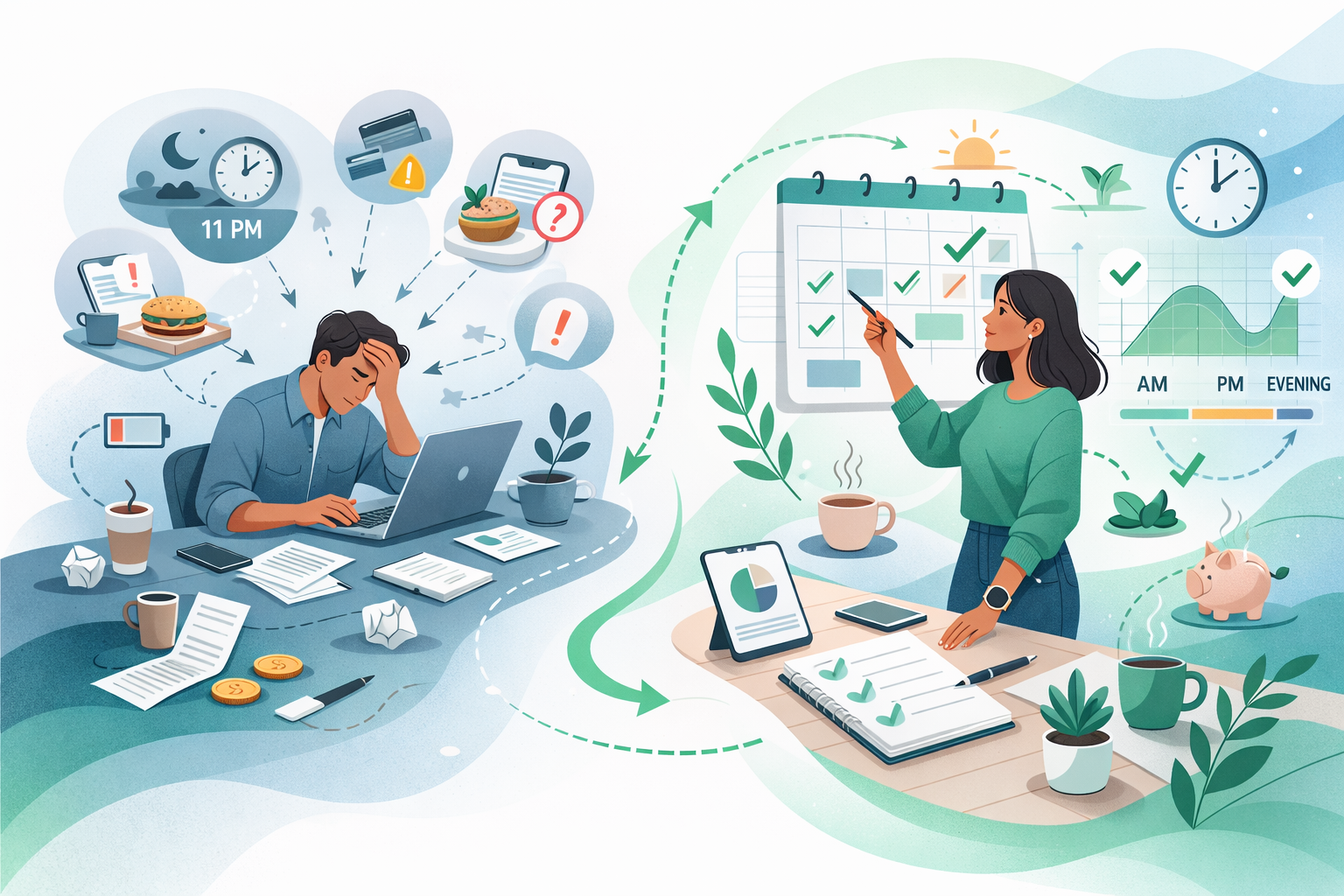
Consider reviewing your finances late at night. Technically possible. Practically unwise. Cognitive load theory explains that working memory has strict limits. Once overloaded, decision quality declines and short term relief begins to dominate long term thinking.
At 6:17 PM on a Wednesday, the mind is not empty. It is crowded. Messages have accumulated. Small financial decisions have already been made. Attention has switched repeatedly, leaving what researchers call attention residue. Sleep may be imperfect. Stress may be mild but constant.
In that state, asking your brain to perform high quality financial judgment is asking for peak performance with reduced resources.
Self regulation research consistently shows that executive function fluctuates with stress, sleep, and decision volume. Scarcity research demonstrates that when mental bandwidth is taxed, even intelligent individuals make choices that contradict their long term interests, not because they do not care, but because capacity is temporarily constrained.
Designing for less willpower means moving cognitively demanding behaviors into high capacity windows and protecting those windows structurally.
You are not designing a stronger self.You are designing around variability.
Stabilize the Cues Before You Strengthen the Habit
Habits do not fail because identity is weak. They fail because context shifts.
During stable weeks, exercise may happen automatically because the gym is on the way home. Then travel disrupts the route. The cue disappears. The behavior weakens.
Habit formation research shows that automaticity emerges from repetition in stable contexts. When cues are unreliable, behavior requires fresh intention each time. Fresh intention requires willpower.
If expense tracking depends on remembering to open an app when you feel like it, the cue is unstable. If it is anchored to brushing your teeth or sitting at your desk at 9 AM, the cue becomes predictable.
Implementation intentions demonstrate that pre specifying the moment of action increases follow through. But the effectiveness depends entirely on the stability of the cue.
Strengthening identity without stabilizing cues creates tension.Stabilizing cues creates traction.
Discipline often looks internal.It is frequently environmental.
Reduce the Number of Decisions, Not Just the Number of Goals
Decision fatigue is not theoretical. It is felt.
You feel it when choosing between cooking and ordering food after a long day.You feel it when deciding whether to log an expense now or tomorrow.You feel it when negotiating with another notification.
Each decision consumes executive resources. Ten small choices can exhaust more bandwidth than one significant one.
A budget that requires manual categorization every day demands repeated self regulation. A meal plan that must be invented nightly under hunger and fatigue competes poorly with convenience. A savings contribution that depends on remembering once a month will eventually be skipped.
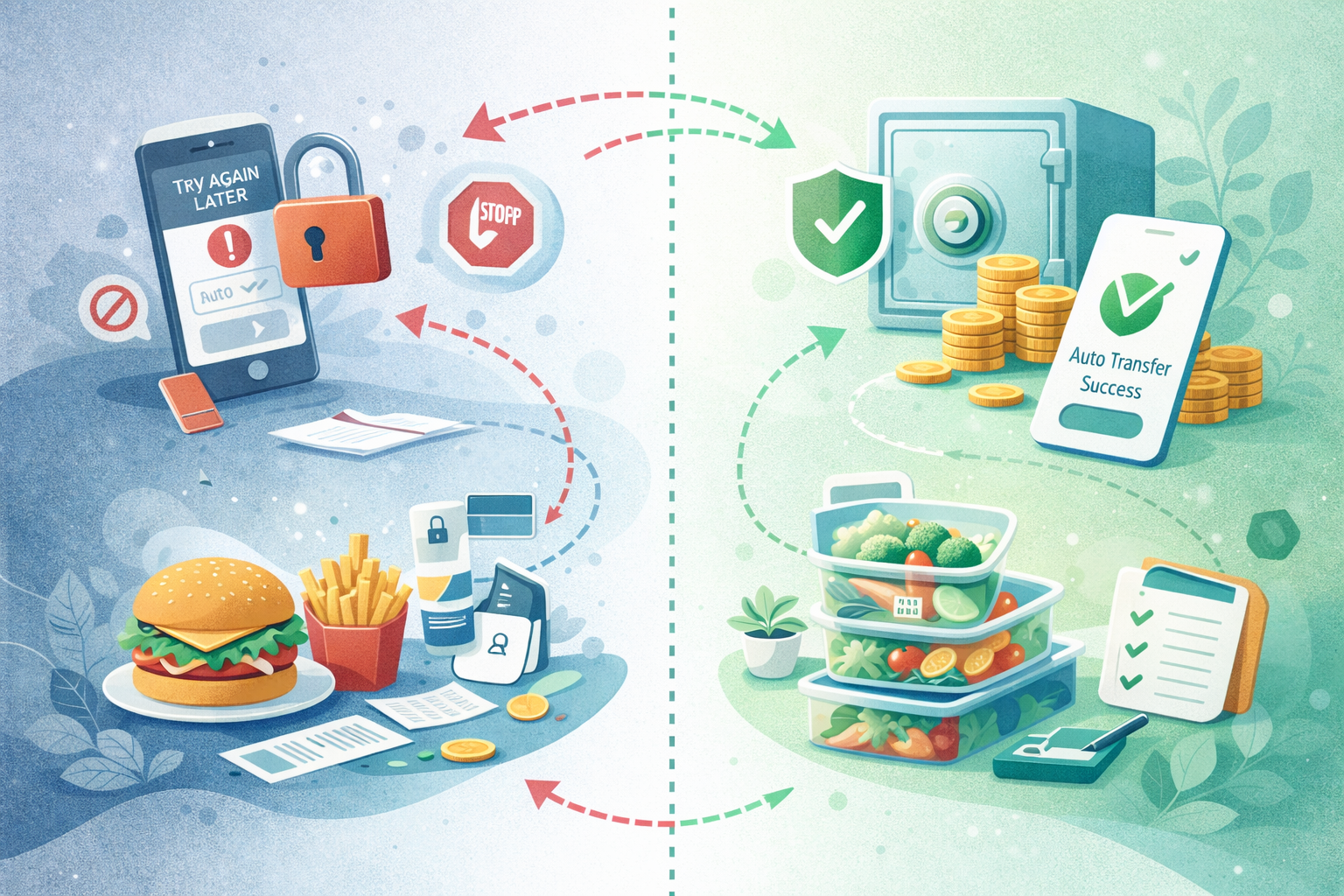
Behavioral economics repeatedly shows that defaults shape outcomes dramatically. Automatic enrollment increases savings. Visible healthy options increase selection. Added friction reduces undesirable behavior.
The subtle but profound shift is this:
Instead of asking how to be stronger tonight, ask how to remove tonight as a decision point altogether.
Willpower is consumed in the moment of choice.Eliminate unnecessary choices and you conserve it.
Shorten Feedback Loops to Match Human Attention
Many breakdowns occur because feedback arrives too late.
Overspending becomes visible at the end of the month.Weight gain is noticed after weeks.Clutter accumulates gradually.
Human attention operates on shorter horizons. When consequences are delayed, behavior drifts.
Real time expense tracking makes patterns visible while adjustments are still small. Weekly calendar reviews embedded in stable routines prevent overload from accumulating unnoticed. Visual cues in physical environments make progress tangible.
Behavioral science consistently finds that immediate reinforcement shapes behavior more powerfully than distant outcomes.
The goal is not surveillance.It is clarity while correction is still manageable.
When feedback is timely and friction is low, minor adjustments require little willpower.When feedback is delayed, correction requires dramatic effort.
Design for Low Motivation Days, Not High Motivation Days
Most systems are built during peak states. Plans assume consistent energy. Routines reflect ideal conditions.
Life unfolds in average states.
The Fogg model emphasizes ability as simplicity. When motivation drops, only simple behaviors persist. If the minimal version of your desired habit is complex, it will collapse during predictable dips.
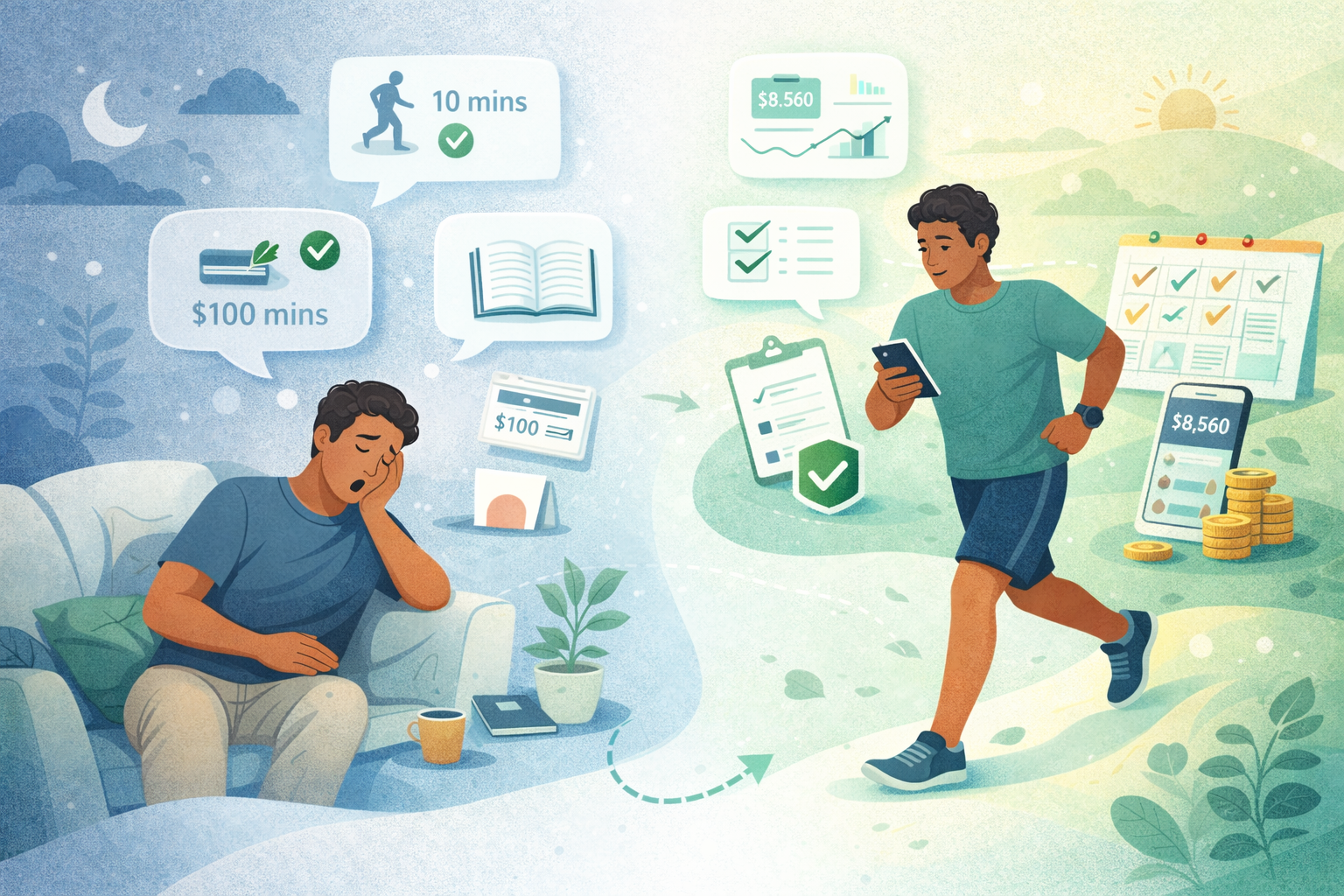
A short walk preserves continuity when a full workout feels impossible.A five minute financial review maintains connection when deep analysis is unrealistic.A single page read sustains identity when focus is limited.
Habit research suggests that consistency builds automaticity more reliably than intensity. Presence matters more than scale in early formation.
Designing for low motivation days protects identity through continuity rather than heroics.
Intensity feels transformative.Stability is transformative.
Increase Ability Before Increasing Pressure
When behavior falters, the instinct is to apply more pressure. Try harder. Commit more seriously.
But if ability is low, pressure increases stress without improving outcomes.
If a budgeting system feels overwhelming, complexity may be the barrier. If exercise feels inconsistent, logistics may be the friction. If task management requires juggling multiple tools, cognitive coordination may be the issue.
The COM B framework reminds us that behavior requires capability and opportunity alongside motivation. Simplifying tools, clarifying steps, and reducing ambiguity increase ability.
Cognitive overload reduces follow through. Simplification reduces dependence on memory and executive control.
Pressure amplifies tension.Simplicity amplifies consistency.
Shift From Self Evaluation to System Evaluation
The most damaging moment is not the behavioral slip. It is the interpretation.
At 6:17 PM, when you order food instead of cooking, the conclusion can become personal. I lack discipline. I am inconsistent.
A structural lens asks different questions. Was the cue unstable? Was the decision placed in a low capacity window? Was friction unnecessarily high? Was feedback delayed? Was the environment competing for attention?
This reframing aligns with research showing that context heavily shapes behavior. It removes moral tone from variability and treats inconsistency as design data.
You are not diagnosing character.You are debugging architecture.
Understanding replaces self criticism.
Build a Life That Absorbs Variability
Motivation will fluctuate. Stress will arise. Attention will fragment in a digital world.
Designing a life that requires less willpower does not eliminate these realities. It absorbs them.
It absorbs variability by automating what can be automated.It absorbs fatigue by simplifying recurring decisions.It absorbs distraction by structuring environments that reduce competing stimuli.It absorbs delayed consequences by shortening feedback cycles.

Technology can support this if configured carefully. Financial systems can run in the background. Reminders can attach to stable cues. Digital environments can be shaped to reduce impulsive pathways. Artificial intelligence can surface insights when bandwidth is available rather than when it is exhausted.
The future does not belong to those who feel motivated every day.It belongs to those who design systems resilient to motivational drift.
A Different Standard for Change
Designing for less willpower is less romantic than chasing inspiration. It rarely produces dramatic narratives.
But it respects biology. It recognizes that executive control is finite. It acknowledges that cognitive bandwidth fluctuates. It understands that friction compounds.
The measure of a well designed life is not how often you feel driven. It is how often the right action occurs without drama.
Change becomes quieter. It embeds itself. It becomes less about proving something and more about protecting something.
You do not need a stronger personality.
You need stronger architecture.
When behavior survives your worst ordinary Wednesday, not just your best inspired Sunday, the design is working.